
Work listed chronologically (generally)

I was bored. So I lied.
The endorphin bliss brought on by thirty minutes of running was hitting as I settled into the small, musky weight room on the last day of a college running class. Students were exchanging half smiles with each other as we filed in. Our teacher was letting us out early so we could pack for the trip home or return to the library to study for final exams still left to take. But before cutting us loose she initiated an eleventh-hour hey, let’s bond a little before parting ways forever.
“So, what’s everyone doing over winter break?” she tossed out to the group with teacherly exuberance. I winced, my bliss interrupted.
In a clockwise hand-off, the class trotted out answers you’d expect.
Hang out with the fam. See friends. Pig out more than I should. Maybe go skiing. SLEEP...and repeat!
Nods and charitable laughter all around. It was like news anchor banter—cordial, cliché, no sharp edges or substance.
In The Usual Suspects, Kevin Spacey’s character, Verbal Kint, weaves a false narrative by stitching in details from things immediately around him—a bulletin board, a pencil, and the bottom of the coffee cup held by the cop that’s grilling him. It’s an artful display of extemporaneous lying. The film came out after I graduated from Berkeley—I was about to be an early version of Verbal.
My turn came and I grabbed a detail and began spinning.
“Funny you mention skiing,” I said. “I’m flying out to Colorado tomorrow for three days of avalanche rescue training.”
“Whoa,” someone blurted. “Damn,” said another. Eyes were on me. I had an audience.
“Yeah—second year in a row. This time it’s for steep-angle situations. That’s 30–50 degrees of slope. Low-angle was last year. It really just means schlepping different gear,” I said, arranging my hand at an angle I considered steep. I felt I’d done a public service. With harmless fibbing I changed the color of the room from beige to chartreuse, creating little frissons for hungry brains. And I amused myself; and when you’re a sleep-deprived, stressed-out undergrad during finals week, you welcome any dopamine hit with gratitude.

I’d never been to Colorado. But it sounded more impressive than nearby Tahoe. The details about slopes and angles were my version of early AI—no clue where I got this. Articles, NPR snippets, television, and internet surfing delivered credence to my low stakes improv.
High-stakes lying is a different beast. In his bestseller, Influence: The Psychology of Persuasion, Dr. Robert Cialdini explains that in wartime history, never has an enemy used less abuse on U.S. prisoners of war, and gained so much intel, than the Chinese during the Korean War. They recognized that if stakes are high, people are more motivated to lie. So, they held essay contests with low-stakes prizes: cigarettes or fruit. This was a tactic to ensure that the prisoners would take responsibility for their written words. America isn’t perfect, would be a typical theme on which POWs would be instructed to write. With a small prize, lying was minimal. The stakes were low. But as the prisoners committed to those thoughts, they became subject to the Consistency Principle.
“The Consistency Principle says that humans have an obsession with sticking to their guns. Consistency is closely related to commitment. Once we’ve committed to a course of action or a belief, we pressure ourselves to conform to that commitment. We go through great mental gymnastics to convince ourselves that our current behavior and beliefs align with our past behavior and beliefs, even when they clearly don’t. This principle can be used for psychological manipulation.”
And when there’s a physical manifestation of your thoughts—handwritten POW essays posted to a wall—there’s more ownership of those thoughts. The artifact makes you want to honor the fiction.
I didn’t know anything about playing the bass but, for one night while downing drinks with friends at the Old Tavern in Sacramento, I became a bassist in a band.
It was a familiar predicament: feeling the beigeness of a scene and looking for a palette change. This time, instead of having to devise something, an invitation presented itself. While knocking back beers in the crowded bar, a guy I’d never met pointed at me and asked, “Aren’t you in a band?”
“Yep.” I tried to quickly inhabit the role. How do cool band members act? I slouched.
“Right. Right,” the guy said, nodding. “Thought so. What’s the name of it again?”
“Nina’s Promise.” I had no Nina in my life. What did she promise? Is this an assessment of her potential? I went on to remind him that I played bass, sang some back-up vocals, and created some album art. The Consistency Principle had me practically reliving memories of some of our better shows. He wanted to know where Nina’s Promise was playing next. The Muses didn’t flinch and I quickly rattled off some smaller venues in the Bay Area.
“Oh nice! I live in Berkeley!”
Staying in character, I nodded, avoiding eye contact, took a long pull from my beer and steered the conversation into neutral waters. Then, with a quick, “I gotta hit the head. Enjoy your night,” I hoofed it down a dark corridor, pulling the plug on my fictitious tour stop.
It’s not that hard to role play for fifteen minutes. Maintaining a ruse for eight weeks demands more: social engineering, continuity, and logistical weirdness. And if you cast your girlfriend in a supporting role, the charade has more reasons to fail.
“Hey—I’ve got an idea,” I said to my girlfriend, stopping her on the sidewalk. “Let’s make it more interesting and pretend we don’t know each other.” It was the first day of a creative writing class we were taking together at The Writing Salon up in the hills of San Francisco.
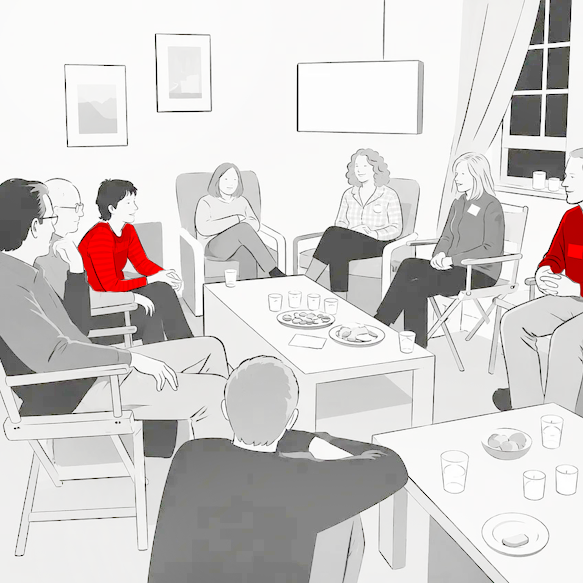
With my girlfriend’s very conflicted “Fine!”, we staggered our arrivals into the large Victorian house, subdivided into cozy writing spaces. We scribbled our names onto Hello, My name is: sticker badges and met each other.
“Nice to meet you,” I said to my girlfriend, shaking her hand during the pre-class small talk. “Ellie. Short for Eleanor?”
We sat away from each other for eight weeks. I circled the block before going to our car after class for eight weeks. I asked her about movies and shows we had watched together, books we both read, restaurants we enjoyed together for eight weeks. Eight weeks of getting to know someone I slept with nightly. The class ended and with it, our performance. And it was just as well—even though contrived, the artifice occasionally strained our relationship. At times my partner felt I might have been a little too quick to smile while chatting with some of the other female writers, making our long drives home over the Bay Bridge either a little too quiet or more the opposite. But our social experiment was done and it had added a nice enhancement to the expensive weekly meet-up. We could exhale.
And then we got caught.
We had dropped into an open house at another campus of the writing school. As we stepped into a classroom our eyes met those of our writing teacher, David. He smiled that smile of a parent catching their kids in the act of something. We got sheepish, just smiling back at him for a second.
“Are you guys married?” He blurted, ping-ponging his eyes on us both. I took ownership of the ruse.
“I love it. I love it. I love it.”
I ran through some of the funny challenges for us, some of the unnoticed, extended touches we gave each other to heighten the experience while he nodded with joy and approval.
—
But sometimes you’re forced to stay in your lie, even after you’re adamant, apologetic, confessing that the jig is up. For about ten years I looked like actor Tim Robbins. I was getting approached everywhere—sitting in the grass at Bryant Park in Manhattan while eating lunch, the Cancun airport in Mexico while slumped low in a chair wearing sunglasses and a hat, and in the frozen aisle at a Trader Joe’s. Whenever strangers drew near, in that tell-tale creep, and gently asked if I was him, I would smile, shake my head, “I get that a lot.”
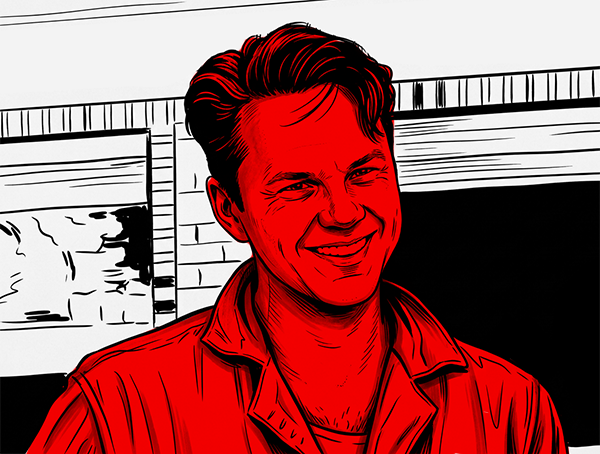
But one night I was bored of saying that. So I lied.
She’d been stealing looks at me from the other end of the bar, sometimes whispering into her friend’s ear afterward. Then, with some liquid courage, she yelled down to me. “Hey you! What’s your name?!” A delighted smile of certainty.
I stared at her, to build a bit of tension, before shouting back with booming, theatrical confidence, “I’m Tim Robbins!”
She unraveled with glee, thrashing her head and shoving her friend, pointing down at me so others could have a look at the Shawshank celebrity. Never mind that he’s six-five and I’m barely six in shoes. It went on for a while.
Then I started feeling guilty. I motioned down at her, crossing my arms back-n-forth the way you would signal someone driving a car to stop and mouthed with slow exaggeration: I’M NOT HIM…I’M NOT TIM ROBBINS…I’M NOT. I shook my head. NOT HIM! I made the knife across the throat gesture. I turned back to my friends––but there she was, beside me suddenly, holding out a napkin and pen. “You said you were. Then you said you weren’t. I’m not taking any chances. Sign this!” She thrust a pen and napkin toward me. “And make it out to ‘Melissa’.”
I was conflicted. Ok, fine. I grabbed the napkin and scribbled out:
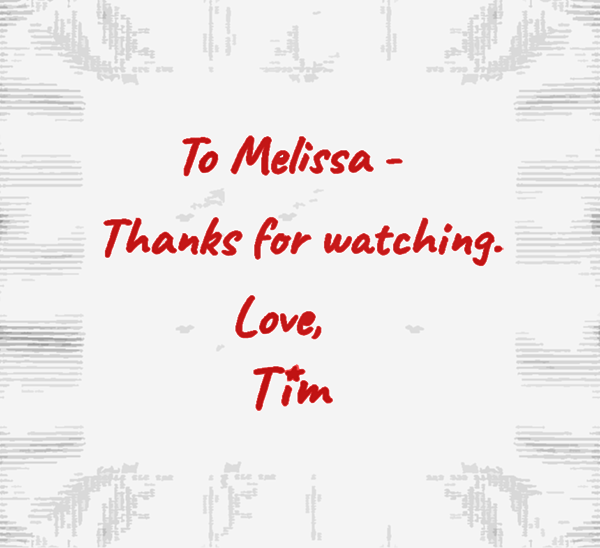
To make it more authentic, give it some Hollywood panache, I dotted the “i” with a tiny star. Sorry, Tim.
I handed it over, hugged Melissa, and made for the exit with my entourage.
Years later, I was walking in Manhattan on a cold, dark, and blustery day when I spotted him—Tim Robbins. He was resting on a public park bench, taking a break from playing street hockey. I paused and thought: now’s my chance. We were on the cusp of not really looking like each other—it had to be now. I could tell Tim about being approached all the time and apologize for signing the napkin for Melissa, especially for using the star in his ‘i’. We’d hit it off and he’d get me well-paying jobs as his double in movies and Nina’s Promise would contribute some tracks.
But my mood matched the weather. Just wasn’t feeling it. I kept my ear buds in, and pushed into the cold wind next to the tall chain link fence, passing within a foot of my doppelgänger—and with it, the chance for a tidy ending to my Tim Robbins chapter. But I’ve always preferred things a little frayed, a little less Hollywood.
A lot more real.